
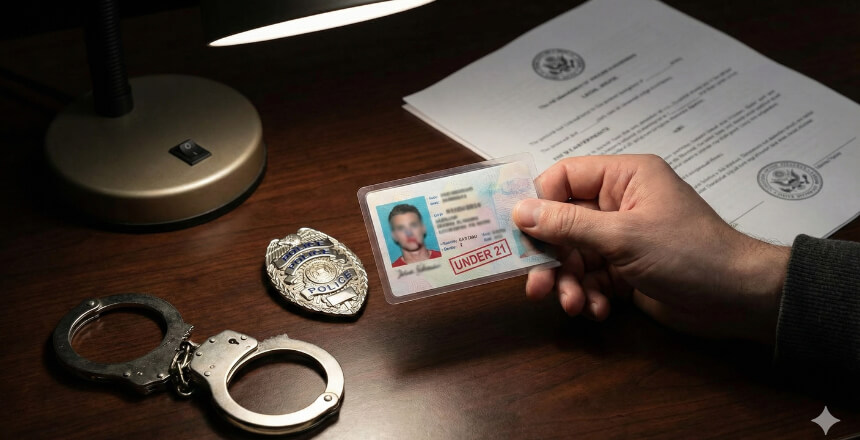
Is Using a Fake ID Illegal? (What the Law Actually Means)
Is using a fake ID illegal? Yes, and the scary part isn’t the word “illegal.”
It’s how fast one dumb decision turns into a real problem you can’t undo. A bouncer takes it. An ID scanner flags it.
A manager calls the police. Now you’re not “trying to get in.” You’re explaining forgery, false identification, and intent to an officer who’s heard every story.
If you’re here because you’re nervous, good. That nervous feeling is your brain doing its job.
In this guide, I’ll show you what the law actually says, why penalties vary by state, and what usually happens when you get caught.
What Counts as a “Fake ID” in Legal Terms
A “fake ID” is any identification document that’s not lawfully issued to you, altered, or made to look government-issued for deception. Federal law even defines a “false identification document” as an ID used to identify people that’s either not issued by a government or was issued but later altered for deceit.
Fake vs altered vs borrowed vs counterfeit
- Fake (generic): an ID that isn’t legitimately issued by the government to the person using it.
- Altered: a real ID that’s been changed (most commonly the date of birth, name, or photo). Example: Florida specifically calls out possessing an ID with an altered DOB as unlawful.
- Borrowed: a real ID that belongs to someone else (even if it “looks like you”). It can still be treated as unlawful possession/use depending on the state and situation.
- Counterfeit: a manufactured “look-alike” meant to appear government-issued (license/ID card), often tied to forgery/counterfeiting concepts.
Possession vs presenting vs using online uploads
- Possession: It’s in your wallet, your bag, your car. Even if you never show it, some laws still care because “having it” can signal intent. Federal law explicitly talks about possessing false IDs in certain unlawful-intent scenarios.
- Presenting: You hand it over or show it to get something: entry, alcohol, a casino wristband, a rental check-in. This is where it stops being a “thing you have” and becomes a “claim you’re making.”
- Online uploads: You upload an ID photo for verification. Now there’s a timestamp, a file, and a transaction trail. That context can make it look less like a dumb moment and more like deliberate deception.
The “intent + context” concept (why the same ID can mean very different trouble)
The law doesn’t just look at the ID. It looks at what you were trying to do with it.
- Alcohol / venue access: Usually treated as a false ID / underage access situation. Still serious, but it’s often handled differently than fraud.
- Fraud (rentals, money, chargebacks, identity): The risk jumps because you’re using identity to gain a benefit. That’s why federal law focuses on fraud and related activity around identification documents and “authentication features.”
- Employment: This is a whole different level. USCIS warns that fraud/false statements or misuse of identity documents can lead to fines and imprisonment.
Why It’s Illegal (Two Buckets of Law)
Using a fake ID is illegal because it usually violates state ID laws (and often alcohol/age-restricted laws) and, in more serious situations, can trigger federal identity-document crimes.
State-level ID + alcohol-access laws
Most fake-ID cases live here.
States generally make it illegal to possess, display, sell, or use a driver’s license/state ID that’s fake, altered, or belongs to someone else. If the situation involves alcohol (bars, liquor stores, clubs), there are often extra penalties because you’re using the ID to access an age-restricted product or venue.
A clean example: Florida law explicitly covers possessing or using an ID that’s false/forged/altered, including IDs with an altered date of birth.
Federal identity-document crimes (when it escalates)
Federal law usually comes into play when the fake ID connects to fraud, identity theft, production/distribution, or misuse of authentication features (the security elements that make an ID “verifiable”).
The main federal statute people cite is 18 U.S.C. § 1028, which covers false identification documents and related conduct in certain circumstances.
The simple rule: alcohol-entry drama is often state-level. The moment it starts looking like money + deception (rentals, employment, banking, travel), the stakes can climb fast.
Is It a Misdemeanor or a Felony? The Triggers That Change Everything
It can be either. A fake ID case is more likely to stay a misdemeanor when it’s a “one-off” tied to age-restricted access. It’s more likely to jump to a felony when it starts looking like fraud, identity theft, or production/distribution.
What flips it into felony territory
These are the moments where the system stops seeing “underage” and starts seeing deception with stakes:
Fraud for money or benefits (rentals, chargebacks, financial accounts). Federal law targets ID crimes tied to fraud scenarios, including possession “with intent to defraud the United States” in certain cases.
Using someone else’s identity (not just a made-up name). If it’s “another person,” the risk can escalate sharply under identity-theft frameworks.
Making, selling, transferring, or holding multiples. Federal law explicitly calls out producing/transferring IDs and possessing five or more with unlawful intent in certain circumstances.
State statutes that label specific fake-ID behavior more harshly. Example: Florida specifically bans possessing an ID with an altered date of birth (and related fraud behaviors) under its driver license statute.
Employment verification lies. Once fake documents touch work authorization/verification, it’s no longer “just a night out.” USCIS notes potential criminal penalties, including fines and imprisonment, for certain prohibited practices and fraud-related conduct.
The takeaway: the card matters, but the story around the card matters more: Why did you use it? What were you trying to get? Who did it hurt? That’s what often decides misdemeanor vs felony.
What Happens If You Get Caught (Bouncer → Police → Court)
Quick answer: Most cases follow a simple path: you get denied, the ID may be taken, and depending on the situation, it can turn into a citation/arrest and then court.
1) At the door (bar, club, venue)
You get denied entry/service. That’s the most common outcome.
The staff may confiscate the ID in some states or be required to turn it over to law enforcement. Rules vary, and some places require a quick handoff to police.
If there’s chaos, arguments, or other issues, that’s when things escalate fast.
2) If police get involved
Police may issue a citation, take the ID as evidence, or arrest depending on the state law and what else is going on.
If the ID belongs to someone else, or it looks like part of a bigger scheme, the risk jumps.
Many jurisdictions treat fake IDs as part of a broader bucket of “fraudulent identification” crimes, and they can add extra charges depending on facts. https://www.sog.unc.edu/blogs/nc-criminal-law/fake-ids-and-criminal-consequences
3) What court usually looks like
First appearance / arraignment: the charge is read, and you enter a plea.
Outcomes vary: fines, community service, probation, diversion programs, or a conviction. (This is where “one night” can become a long-term problem.)
If the case hints at fraud, multiple IDs, or distribution, consequences can escalate because federal law targets certain ID-document crimes in specific circumstances.
Bottom line: the moment it stops being “a dumb try at the door” and starts looking like deception for access or benefit, your risk profile changes.
High-Risk Situations (Where Consequences Spike Fast)
The risk jumps when a fake ID gets tied to security checkpoints, money, or regulated venues. Not because the card magically changes, but because the stakes change.
Airports (TSA checkpoints)
Airports don’t “handle it like a bar.” TSA’s job is identity screening to access secure areas, and they publish strict ID rules for the checkpoint.
If you create doubt about who you are, you can end up stuck in extended screening or denied entry to the sterile area. And if the situation looks like identity document fraud, federal law has a dedicated statute covering fraud and related activity involving identification documents and “authentication features.”
Rentals (Vrbo/Airbnb-style check-ins)
Vacation rentals are a money-and-liability business. Hosts and platforms care about chargebacks, property damage, party risk, and insurance.
Vrbo specifically explains that identity verification helps build trust, but it’s not universally required to book, and hosts may still ask for ID in some contexts or countries.
If an ID problem pops up here, it’s not just “denied entry.” It can turn into cancellation, deposit issues, disputes, and fraud allegations because the booking is a paid transaction.
Casinos (ID scanning + surveillance + compliance)
Casinos operate under heavy compliance pressure: age rules, self-exclusion lists, and security protocols. That’s why many casinos use ID verification systems and scanners designed to validate IDs and reduce fraud.
Even if you think you’re “just trying to get in,” casinos often treat suspicious IDs like a security event, not a misunderstanding.
Bottom line: bars are one layer. Airports, rentals, and casinos are a different league because identity ties directly to security and money.
Can a Bouncer Confiscate a Fake ID?
Sometimes, yes but it depends on the state. In many places, the venue can refuse service no questions asked. Confiscation is trickier because some states allow it only if the business follows specific steps.
When confiscation is allowed (example: California)
California spells it out for alcohol service: a licensee or employee may seize an ID that’s false or shows the person is under 21, but they must give a receipt and turn it over to local law enforcement within 24 hours.
So the real-world version looks like:
- they keep the ID,
- they write you a receipt,
- they hand the ID to police within a day.
When confiscation isn’t “automatic”
Even if the staff thinks it’s fake, not every state gives them the same permission or process. That’s why you’ll see different outcomes from city to city: some places take it, some hand it back and just refuse entry, some call a manager, some call police.
One important detail most people miss
Even in states that allow confiscation, venues aren’t supposed to “keep it as a trophy.” If the law allows seizure, it typically comes with a handoff requirement (like the 24-hour rule above).
Can ID Scanners Detect Fake IDs?
Sometimes. ID scanners can catch a lot of fakes, but they’re not a magic lie detector. Most scanners mainly validate machine-readable data (like the PDF417 barcode) and look for data that doesn’t match known formats.
What scanners usually check
- Barcode reads at all (PDF417/MRZ): If it won’t scan or the data is malformed, that’s a red flag.
- Format + field logic: Systems compare the extracted fields (DOB, expiry, issue date, document number patterns) against expected structures and flag anomalies.
- Data consistency: Some workflows also compare barcode output against what’s printed (or what the camera reads).
Why scanners still miss some fakes
Because scanning is often one layer, not “proof.” A barcode can be made to look valid, and a scan doesn’t always confirm the document is genuinely issued by a DMV. Even AAMVA’s design standard describes the barcode as a way for law enforcement to electronically verify details, not as a guarantee that every scan equals authenticity.
That’s why stronger verification programs use multiple checks (document + data + risk signals), not just a quick scan.
Can AI Make a Fake ID? (And Why This Is Getting Worse)
AI can generate very convincing fake-ID images, yes. And that’s exactly why people are getting trapped harder than ever.
Here’s the twist: the “AI made it perfect” vibe doesn’t make you safer. It usually makes you more confident, which makes you more careless. And the moment you upload, send, or use that image in a real process, it stops being “a picture” and starts looking like identity document fraud.
Federal law treats “false identification documents” as documents meant for identifying people that weren’t issued by a government (or were later altered for deceit).
And modern verification programs don’t rely on one check. They validate document authenticity and data validity as separate steps (think: “Is the evidence genuine?” and “Does the data check out?”).
What this means for real life:
AI fakes don’t just create “better fakes.” They create more scams, more leaks of personal photos, and more situations where someone thinks they’re in control… right up until a system flags the document or someone reports it.
Need a Reliable Fake ID Fast?
Order Yours →FAQs
Pretty much, yes. The wording changes, but every state criminalizes some mix of possessing, using, altering, or presenting false identification. The “how bad” part depends on the state statute and what you were trying to do with it. (Example: Florida specifically bans possessing an ID with an altered date of birth.)
Often, but not always. Many “one-off” situations (like trying to buy alcohol) are charged as misdemeanors in a lot of places. But if the facts look like fraud, identity theft, or production/sale, the same issue can escalate quickly. Federal law also targets certain ID-document conduct in defined circumstances.
It tends to flip when it’s tied to fraud, multiple IDs, selling/producing, or using someone else’s identity. Federal law (18 U.S.C. § 1028) specifically covers producing/transferring/possessing false IDs and related authentication features in certain circumstances.
Confiscation depends on state law. For example, California allows licensees/employees to seize a false/underage ID, but they must give a receipt and turn it over to law enforcement within 24 hours.
If police get involved, the ID can be treated as evidence and you may get a citation, a report, or an arrest depending on local law and the overall situation. The “extra details” matter a lot here: whether it’s altered, belongs to someone else, or connects to another offense. (State laws define what’s illegal; Florida’s statute shows how specific these rules can get.)
TSA requires acceptable identification at the checkpoint and has clear rules on what IDs are accepted. If your identity can’t be verified, you can be delayed or denied access to the secure area. And if the situation looks like identity document fraud, federal law is the wrong place to play games.
Sometimes. It depends on the state. In California, seizure is allowed but comes with strict handling rules (receipt + 24-hour turnover to law enforcement). If a venue is allowed to seize, it’s generally not “keep it forever” it’s “document it and hand it off.”
Sometimes. Many scanners validate the machine-readable data and flag formatting/data issues, but scanning isn’t a universal “authenticity stamp.” It’s one layer of verification, not a magic truth machine.
Wrap-Up
Is using a fake ID illegal? Yes, in most cases, and the consequences depend on what the ID is, how you used it, and why.
The “why” matters because the law treats a fake ID differently when it’s tied to alcohol access vs fraud, employment, or security checkpoints.
Federal law also covers fraud and related activity involving identification documents in certain circumstances.