
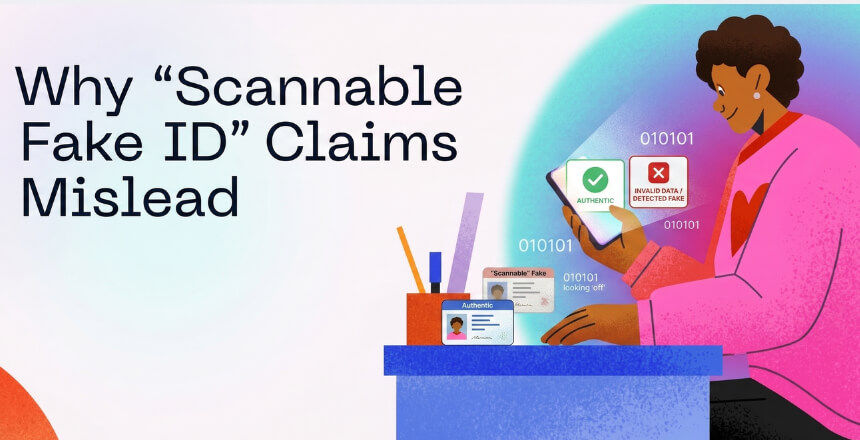
Why “Scannable Fake ID” Claims Mislead
Scannable fake ID sounds convincing because it gives people one simple promise: if it scans, it must be good.
That is where the lie starts.
A scan is not the same as trust. It is not the same as legitimacy. And it definitely is not the same as a real identity document.
Real U.S. driver license and ID systems are built around standardized human-readable and machine-readable data, issuer identification, and broader security design standards, while consumer protection guidance warns people not to trust polished online claims at face value.
Get A Scannable Fake ID Fast
Order Yours →Why that word sounds so powerful
The word scannable calms people down.
It makes them think the hard part is solved. If the barcode works, the card must be believable. If the scanner reacts, the card must be safe. If it passes one machine, it must pass everything.
Real life is not that simple.
A barcode is only one layer. Real ID checks can involve card design, encoded data structure, issuing-jurisdiction identifiers, visual security features, and the context in which the card is being used. AAMVA’s driver license and identification standards exist specifically to improve security and interoperability across jurisdictions, which tells you right away that a working scan is only one piece of a much larger system.
A scan is not the same as a real check
This is the part a lot of people miss.
Something that “scans” may only be doing the bare minimum needed to trigger a reader. That does not mean the underlying data is trustworthy. It does not mean the card matches official issuance standards. And it does not mean the rest of the credential holds up under normal visual or system-level inspection.
That matters because people hear one technical word and assume total credibility.
But document checks are rarely built on one word or one moment. They are built on layers. The AAMVA standard covers human- and machine-readable data, jurisdiction identifiers, and card design considerations because identity documents are supposed to work as part of an ecosystem, not as a one-trick barcode performance.
Why sellers lean on the word so heavily
Because it is easy to sell.
“Scannable” feels technical without being specific. It sounds like proof, even when it is just marketing language. It gives nervous buyers something short to hold onto.
That is exactly why misleading online sellers use this kind of claim.
Consumer advice from the FTC tells people to search for complaints, compare experiences, and slow down before trusting an online seller, which is a direct warning against relying on polished claims alone.
Why people believe it anyway
Because it answers the wrong fear in a very convenient way.
Most people are not asking whether a document is legitimate in a technical sense. They are asking whether it will “work.” That makes them vulnerable to a shortcut promise.
If someone is already anxious, rushed, or afraid of getting fooled, the word scannable feels like reassurance.
But reassurance is cheap online.
That is why the claim works so well. It sounds measurable, even when the seller never explains what kind of scan, what kind of system, what kind of data, or what standard they are even talking about. AAMVA’s materials make clear that official ID ecosystems rely on standardized structures and versioning, not vague buzzwords.
The hidden trick behind the claim
The trick is that scannable is usually presented like an end result, when really it is just a narrow technical suggestion.
Even in legitimate identity systems, machine-readable elements exist alongside visual checks, security features, issuer rules, and jurisdiction-specific requirements. So when a seller reduces everything to “it scans,” they are shrinking a complex document standard down to one comforting phrase.
That is what makes the claim misleading.
Not because it sounds flashy.
Because it quietly teaches people to judge an identity document by the weakest possible test.
Why “scannable” does not answer the real question
The real question is never just, “Will something scan?”
The real question is whether the whole credential stands up to the kind of check it is likely to face.
That includes visual inspection, data consistency, issuing logic, and whether the document behaves like something that came from a real identity system. Identity standards exist to support reliability and interoperability, not to create a single buzzword people can use as a shortcut for trust.
So when someone sells “scannable” as the whole story, they are selling certainty that the word itself cannot deliver.
Why this kind of language belongs in the same bucket as other risky online claims
Because it is vague on purpose.
The FTC’s shopping advice is useful here even outside this specific niche: check complaints, compare what others say, and do not treat professional-looking claims as proof. That is exactly the kind of caution people forget when a seller starts using confident, technical-sounding language.
In other words, “scannable” often works more like a persuasion term than a meaningful standard.
It sounds precise.
It usually is not.
Final thought
“Scannable fake ID” sounds persuasive because it gives people one small thing to believe in.
That is exactly why it misleads.
It turns a complicated question about identity documents into one easy marketing promise. And once someone believes that one promise is enough, they stop asking better questions.
That is usually when the trouble starts.
Frequently Asked Questions
Because it makes people think one machine-readable element proves the whole document is trustworthy, when real ID systems rely on multiple standards and checks.
No. A scan is only one part of a broader identity and document-checking system.
Because it sounds technical, calming, and specific, even when the claim itself is vague.
Standardized data structures, issuer identifiers, card design rules, and visual plus machine-readable verification all play a role.
Treat them like marketing until they are backed by something concrete, and check complaints and outside signals before trusting the seller.
Because people often trust technical-sounding language too quickly, especially when they are already nervous or rushed.