
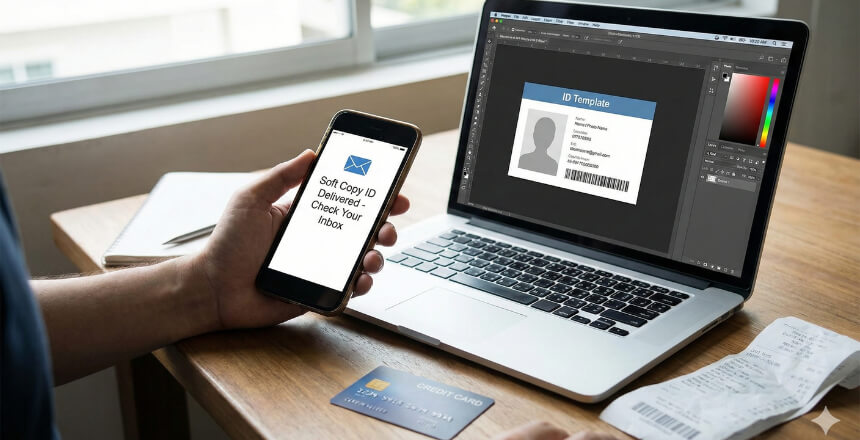
The “Soft Copy Fake ID” Trap That Gets People Scammed in Minutes
You’re not trying to “buy a fake ID.” You’re telling yourself it’s harmless because it’s just a soft copy. Just an image. One-time use. Quick fix.
And that’s exactly why scammers pounce.
Because the second you ask, the script starts: “DM me.” “Telegram only.” “Pay first.” “Real vendor.” “Verified.” Then the “small extra fee” shows up… and you’re either ghosted or pushed into sharing something you’ll regret.
In this post, I’ll break down how the soft copy fake ID trap works, the red flags people miss in minutes, and what to do if you already sent money or shared an ID photo.
The “soft copy” illusion
“Soft copy” sounds harmless, right?
It’s not a plastic card. It’s not something you’ll flash at a bouncer. In your head, it’s just a photo or just a scan you can use once and delete.
That’s the illusion.
Because the moment you say “soft copy,” you’ve basically told scammers two things: you want it fast and you think it’s low risk. That combo makes you the easiest person in the room to squeeze.
Here’s why scammers love it. They don’t need to “deliver” anything. They just need to get you into a Telegram DM, show you a couple of fake vouches, take an upfront payment, and disappear. Low effort. High volume. Zero accountability.
And even if you’re careful, clones are everywhere. Research on Telegram scams shows fake or cloned channels are hard to spot, even for advanced users.
How the scam works in real life
This is why people get fooled.
It doesn’t start with a “scam vibe.” It starts with someone who sounds helpful, replies fast, and drops a Telegram handle like it’s normal. Then they push you into a DM, show “proof” (screenshots, vouches, a channel), and ask for a small upfront payment.
After that, the script stays the same:
You pay.
They add a “small extra fee.”
You pay again.
They either ghost you or keep squeezing.
This works because Telegram makes impersonation cheap and scalable. A large-scale research study that analyzed 35,382 Telegram channels and 130+ million messages found that fake and clone channels are common, and that fake channels are hard to identify even for advanced users.
And the damage isn’t rare. FTC data shows consumers reported more than $12.5 billion in fraud losses in 2024, a 25% increase from the prior year proof that scams aren’t just everywhere, they’re getting more effective.
Why Telegram is the scammer’s favorite channel
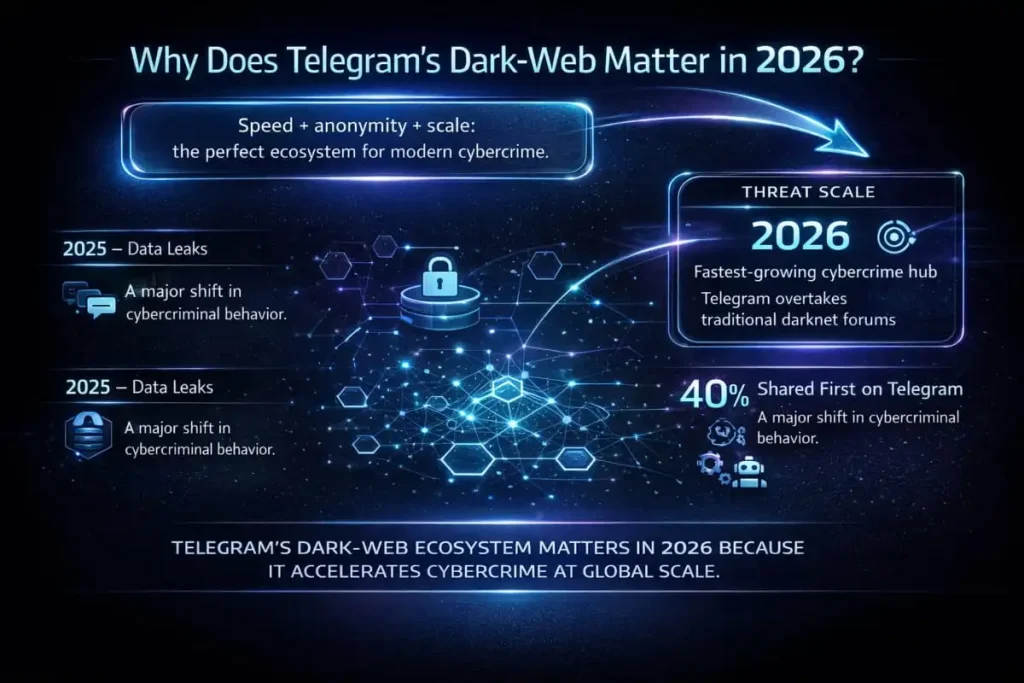
Telegram makes scams feel “normal” because it looks like a marketplace, not a crime scene.
You’ve got channels that look professional, comments that look like reviews, and people who answer fast like they’re running customer support. That setup lowers your guard. And once you’re in a DM, the scam becomes private, fast, and hard to reverse.
Two things make Telegram especially attractive:
1) It’s easy to hide and reset.
Accounts are disposable. Channels can be created, renamed, and rebranded quickly. If one handle gets reported, another one pops up.
2) It’s easy to run phishing-style scams at scale.
Security researchers have documented Telegram “markets” being used as a breeding ground for modern phishing and fraud operations, because distribution (channels + forwards) and conversion (DMs) happen in the same app.
And if you’ve ever thought, “This person seems legit,” that’s also part of the trap. Telegram itself has issued guidance about common scams that rely on impersonation and social engineering, which is basically what’s happening when someone pushes you to pay in a DM.
Red flags that show you’re being played
Most people don’t get scammed because they’re “stupid.”
They get scammed because the red flags don’t look like red flags when you’re in a hurry.
Here are the giveaways that you’re not dealing with a real person offering help you’re dealing with a script.
They move you off the thread immediately
“DM me” isn’t a convenience. It’s a filter. It gets you away from witnesses, warnings, and accountability.
They sell confidence instead of proof
Watch for phrases like “real vendor,” “verified,” “guaranteed,” “scannable,” “100% legit.” That language is designed to replace evidence with certainty.
They rush the payment step
Any version of “pay first,” “deposit,” “booking fee,” or “small upfront” is the start of the squeeze. After you pay once, the “one more fee” is almost automatic.
They show fake social proof
Screenshots of chats, blurred “orders,” and generic vouches are easy to manufacture. Real trust doesn’t need a slideshow.
They push irreversible payments
Crypto, gift cards, and other hard-to-reverse methods are popular for a reason.
If you want a simple rule that keeps you safe, use Telegram’s own scam guidance: be extra skeptical of impersonation, “too good to be true” offers, and anyone pressuring you to act fast.
What are the biggest red flags that a “soft copy” deal is a scam
If you only remember one thing, remember this: a scammer always tries to remove your ability to think. They do it with speed, secrecy, and pressure.
Here are the biggest red flags, in plain English:
- You’re pushed into a DM right away – That’s not “privacy.” That’s isolation. It stops other people from warning you.
- They talk like a brand, not a person – “Trusted vendor.” “Verified.” “Guarantee.” “Scannable.” Real people explain. Scammers label.
- They won’t answer basic questions publicly – If everything is “DM for details,” it’s because details are where the lies fall apart.
- They want upfront money before anything else happens – The first payment is the hook. After that comes the upsell loop, or the ghost.
- They demand an irreversible payment method – Anything that’s hard to reverse is a signal they don’t plan to be around later.
- Their proof is screenshots and vouches only – Screenshots are cheap. Fake reviews are cheaper. If their “trust” relies on images and hype, it’s usually a performance.
Telegram itself warns users to watch for impersonation, urgent pressure, and scams that look like “services” offered via messages.
The real danger is what you share, not what you buy
Losing money hurts.
But what sticks with you is what you hand over in the process.
Because once you’re in a DM, the “soft copy” request often turns into a data request. A clearer photo. A selfie. Your address “for delivery.” One more document “for verification.” And every extra detail makes you easier to exploit.
A clean image of a government ID isn’t just a picture. It’s a bundle of high-value identifiers name, date of birth, address, ID number, and your face. That’s why identity misuse is the bigger long-tail risk here.
To put a real number on it, the FTC says it received more than 1.1 million identity theft reports in 2024 through IdentityTheft.gov alone.
And Telegram’s own scam guidance calls out the exact tactic behind this impersonation and urgency used to pressure people into sharing sensitive info fast.
What should you do if you already sent your ID photo or personal details
First, don’t panic. But don’t “wait and see” either.
A photo of your ID is enough for scammers to try impersonation, account takeovers, and long-tail identity theft. The FTC logged 1.1+ million identity theft reports in 2024, so this isn’t some rare edge case.
Here’s what to do, in order:
- Cut the line: Stop replying. Don’t argue. Don’t send “one last thing.” Save screenshots and usernames.
- Secure your money pipes: Call your bank/payment provider immediately and flag the transaction as scam-related. If you used UPI/card/wire, speed matters.
- Lock your identity down: If you’re in the U.S., go to IdentityTheft.gov and follow the step-by-step recovery flow. If credit is involved, place a fraud alert or credit freeze (CFPB also recommends this).
- Watch for follow-up attacks: Expect “recovery scam” messages like “we can get your money back.” That’s usually scam wearing a suit. Telegram itself warns about impersonation and social engineering tactics like urgency and fake authority.
Can face verification detect a fake ID image
Most of the time, yes because face verification isn’t just “does the face look similar.” Modern identity checks usually combine face match (selfie vs ID photo) with liveness detection (proving it’s a real, live human in front of the camera, not a photo, screen replay, or deepfake).
That’s why the “soft copy” idea falls apart when a site uses proper verification. A clean-looking image might pass a casual human glance, but automated systems are built to catch presentation tricks and synthetic media.
IDScan tested 200 AI-generated fake ID images and reported they caught 84% with image/symbology analysis alone, and 99.6% when combined with additional checks.
If you got scammed, do this next
Here’s the mistake people make after getting scammed.
They go quiet. They feel embarrassed. They hope it just “goes away.”
That delay is where scammers win twice.
Do these three things immediately:
1) Save the proof and cut contact
Screenshot the chat, the username, the channel link, and any payment receipts. Then stop replying. Scammers often come back with a “last chance” message just to squeeze one more payment.
2) Try to stop the money, even if you think it’s too late
Contact your bank or payment provider and report it as fraud. Even when reversals don’t work, reporting creates a trail and can help prevent repeat charges.
3) Lock down your identity if you shared documents
If you sent an ID photo or personal details, file a report and follow the recovery steps at IdentityTheft.gov. The CFPB also recommends placing a fraud alert or security freeze and taking steps to protect your credit if identity theft is involved.
One reason to take this seriously is scale: the FTC says consumers reported losing $12.5 billion to fraud in 2024, up 25% from the prior year.
Safer ways to handle legitimate ID verification online
Not every ID request is a scam. Some platforms do use real KYC and age verification.
The problem is, in the moment, it’s hard to tell the difference. So here’s a simple rule that saves you: real verification happens inside an official flow. Scams happen in DMs.
If a company is legit, they’ll ask you to verify inside their website or app, using a secure upload screen. They won’t send you to a random Telegram handle. They won’t pressure you to “pay a fee to verify.” And they definitely won’t ask for extra selfies over chat.
Before you upload anything, do a 20-second check:
- Are you on the real domain/app (not a forwarded link or a lookalike page)?
- Is there a support page and a real way to contact them (email/ticketing, not “DM only”)?
- Are they asking for only what’s necessary, or are they fishing for extra details?
At topfakeids.com we believe in quality over quantity. We’ve been in this industry over a decade and we’ve build that reputation because make each id with passion and details. However, we never recommend use it against law or illegal activity.
We also don’t want you to fall for scam, loose money and data.
Safer alternatives for age-restricted access
Most vendors selling IDs are made with cheap plastic. They take your money, block your handle, and leave you on the sidewalk with an empty wallet.
They sell junk. We sell science.
At topfakeids.com, we don’t do “shortcuts.” We do precision engineering.
Why topfakeids.com is the only “No-BS” option in 2026
Tired of “deposit-first” scams and pixelated inkjet garbage? Move to the big leagues. Here is why we’re the gold standard:
- We don’t scam. Period. No burner Telegram accounts. We deliver exactly what we promise. Every. Single. Time.
- Material Integrity. Others use flimsy PVC. We use 100% Polycarbonate. Our cards ring like metal because they use the same substrates as the real deal.
- Forensic Accuracy. We don’t just “print.” We reverse-engineer AAMVA Version 10 logic. Our barcodes pass the deep-level logic checks that AI scanners use to catch amateurs.
Total Data Purge. Your safety is our business. Once your order is delivered, your data is wiped. We build trust, not databases.
If you want a document that works place your order. We do it right, or we don’t do it at all.
Get a Scannable ID That Never Fails
Get Scannable ID →Final Words!
Either you’re about to DM a stranger because you “only need a soft copy”… or you already did, and now your gut feels weird.
Listen to your gut.
These scams don’t win because they’re smart. They win because they move fast. They isolate you in DMs and force you to pay before you think. The moment a stranger pushes urgency or sends “proof” that’s just a grainy screenshot, you aren’t buying anything. You’re being processed.
Here is what you do right now: Close the DM. Keep your documents to yourself. Don’t send another dollar to “unlock” a package that doesn’t exist.
If you need a sanity check, use FakeIDs.com as your safety hub. We track scam patterns and red flags so you don’t get hit twice. We show you what to do if you’ve already shared your info and how to lock down your identity before it’s too late.
Losing money hurts.
But handing a stranger your identity hurts a lot more.
Stop being a mark. Go to FakeIDs.com and get the facts before you get played.