
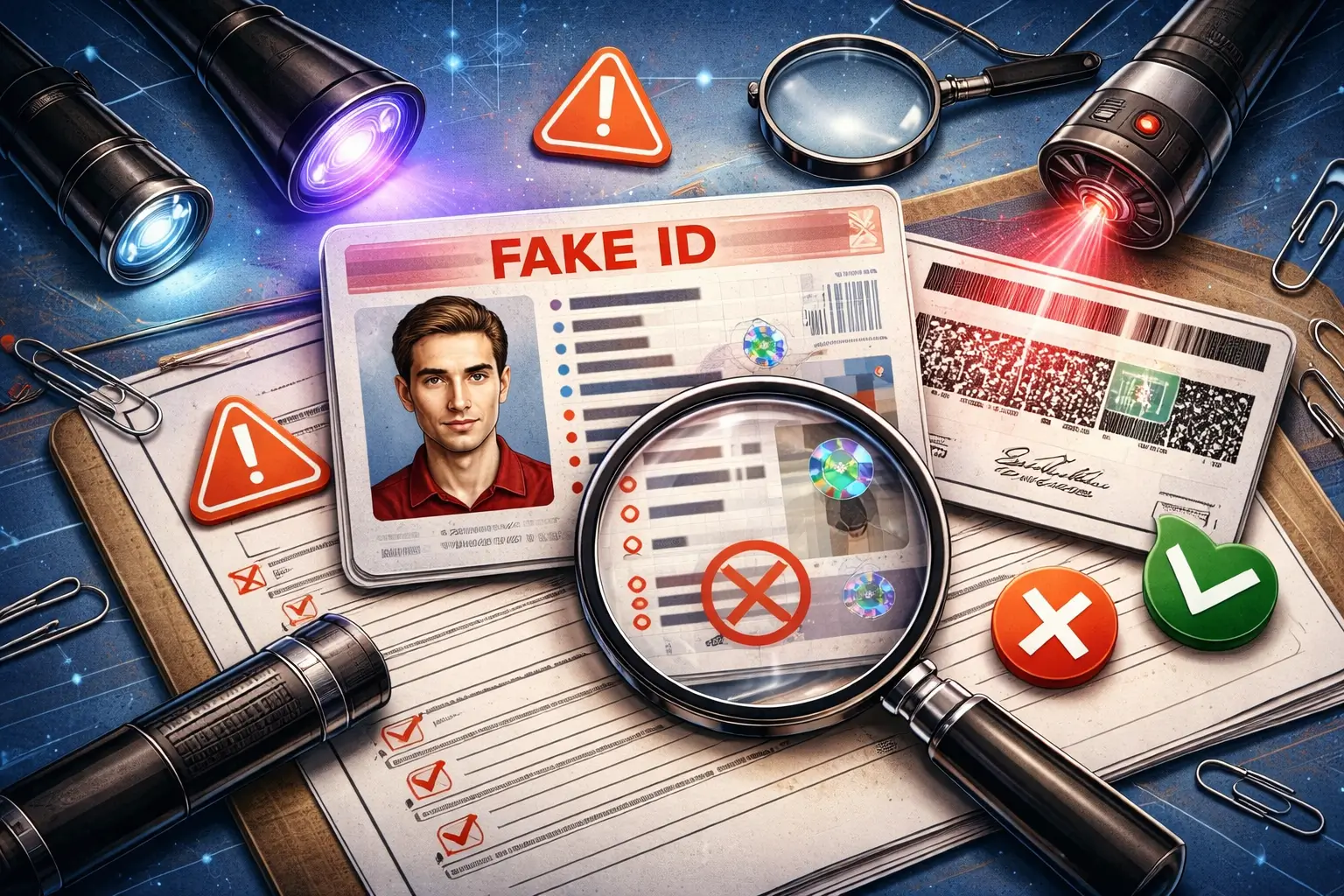
How to Spot a Fake ID Using Photo, Layout, and Barcode Clues
Most people look for the wrong thing.
They check the age.
They check the face.
They see a barcode.
And they think that’s enough.
It isn’t.
Bad IDs usually don’t fail in one big way.
They fail in three smaller ones:
the photo,
the layout,
and the barcode area.
That’s where the card starts leaking trust.
And that matters because modern U.S. IDs are not just plastic cards with printed details. Under REAL ID rules, compliant cards must carry a full facial digital photograph on the front and a PDF417 machine-readable zone on the back. DHS’s REAL ID material lays out those required elements, and AAMVA’s secure card design guidance makes the bigger point clear: real IDs are built as secure document systems, not a pile of separate features.
Don’t Get Left Behind, Get Your Fake ID
Order Yours →Start with the photo
This is where people react fastest.
Not because they know ID standards.
Because they know faces.
If the image looks too dark, too blurry, badly cropped, stiff, or lower quality than the rest of the card, people notice. Official U.S. photo guidance rejects shadows, glare, weak exposure, poor clarity, and facial obstruction for the same reason: once the face becomes hard to trust, the whole document gets weaker.
A weak photo doesn’t just hurt the image.
It weakens the whole card.
Then check the layout
A real ID usually looks controlled.
The spacing feels settled.
The text weight feels consistent.
The card doesn’t look like it’s trying too hard.
That’s one of the details people miss.
A fake layout often gets close, but not cleanly. The fields may be present, but the rhythm feels shaky. The print may look almost right, but not stable. DHS’s REAL ID framework requires core front-side fields like name, date of birth, address, signature, issue date, expiration date, document number, and facial image, while AAMVA’s design guidance emphasizes that secure cards need coordinated design, not just copied elements.
So the better question is not:
“Is the information there?”
It’s:
Does it look like it belongs there?
Now check the barcode area
This is where people get lazy.
They see a barcode and assume the hard part is over.
It’s not.
REAL ID requires the machine-readable portion to use PDF417 and carry defined minimum data elements. But that only tells you what the credential is supposed to contain. It does not mean every barcode-looking back side is trustworthy. AAMVA’s standards work exists because machine-readable conformity and secure card design have to be implemented properly, not just approximated.
So when you look at the back, ask:
- does the barcode zone feel intentional
- does the print quality stay sharp
- does the spacing look disciplined
- does the back feel like part of the same credential
A bad card can have a barcode.
That does not mean the back is convincing.
Here’s the part most people miss
A fake ID rarely loses because one feature is missing.
It loses because one zone falls below the others.
The photo looks weak.
The layout looks unstable.
The barcode area looks cheaper than the front.
That break in quality is what people notice.
Even when they cannot explain it clearly.
And that idea is not just intuition. AAMVA’s secure design guidance explicitly argues against relying on one feature and instead focuses on how multiple security and design elements work together across the full card.
The simplest way to check an ID
Use this order:
1. Photo
Does the face look clear, natural, and high enough quality to belong on the card?
2. Layout
Does the front look calm and controlled, or is it trying too hard?
3. Barcode area
Does the back look structured, or does the quality drop?
That order works because it matches how doubt usually builds.
Identity first.
Design second.
Technical structure third.
Final thought
If you want the shortest answer, here it is:
Don’t ask whether the card has the right features.
Ask whether the photo, layout, and barcode area all hold the same standard.
That’s where weak cards usually fall apart.
Frequently Asked Questions
The easiest clues are a weak facial image, unstable front-side layout, and a barcode area on the back that looks poorly printed or badly integrated. DHS REAL ID guidance defines what compliant cards must contain, while AAMVA’s secure card design guidance explains why those elements must work together.
No. A compliant ID uses PDF417 and defined machine-readable data elements, but barcode presence alone does not prove the whole document is authentic.
Because people read faces quickly, and official guidance stresses proper facial visibility, lighting, focus, and image quality. A weak facial image damages trust fast.
Uneven spacing, shifting text weight, sloppy alignment, weak finish, and a front side that feels copied rather than controlled are common warning signs. AAMVA’s design guidance treats secure IDs as coordinated systems, not separate features.
It should look structured and deliberate, with a properly implemented machine-readable zone that fits the rest of the card. REAL ID defines what that zone must contain, and AAMVA’s standards aim to improve uniformity and trust across jurisdictions.