
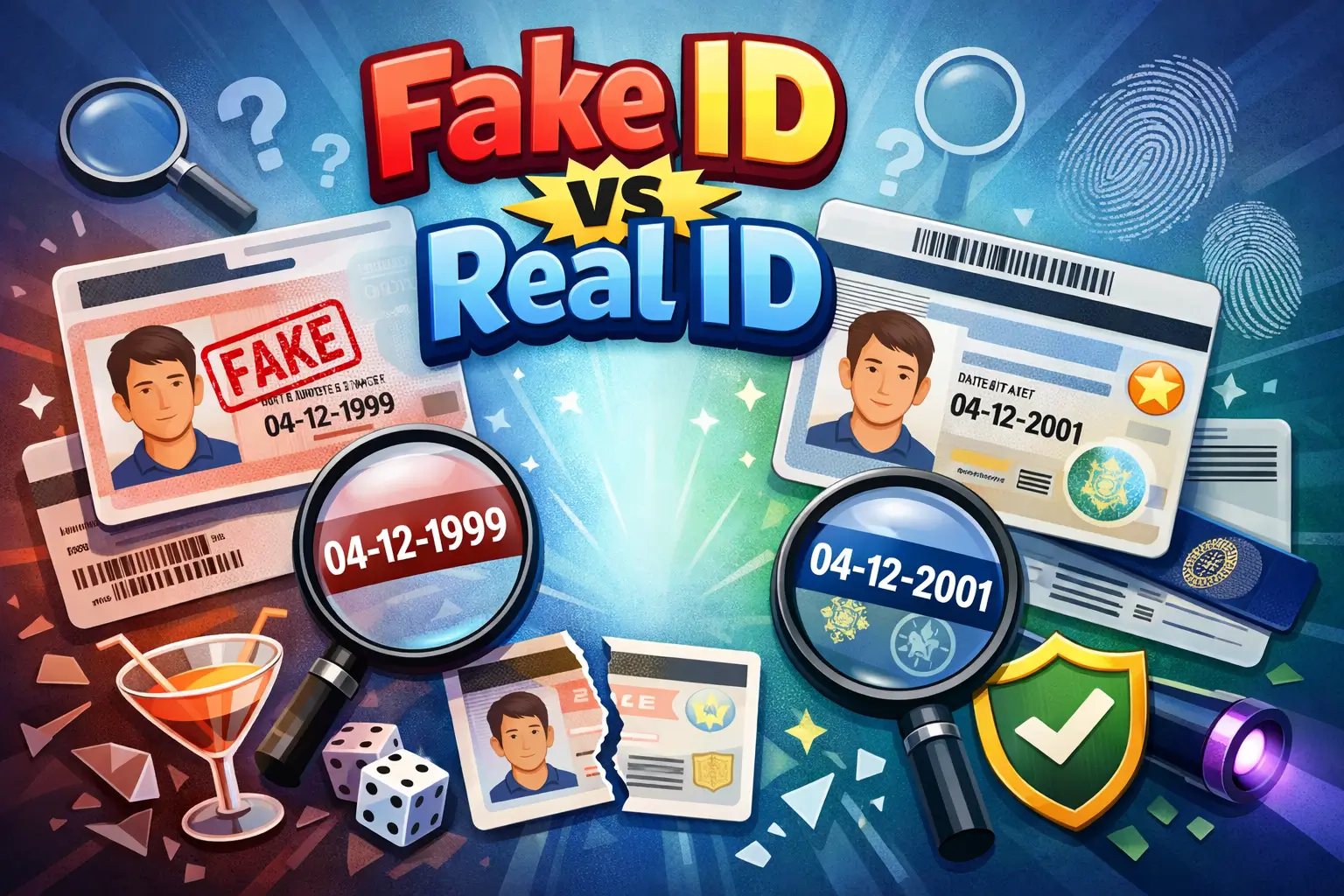
Fake ID vs Real ID: The Front-and-Back Details People Miss
Most people compare IDs the wrong way.
They hunt for the dramatic stuff.
- A shiny hologram.
- A barcode on the back.
- A photo that looks close enough.
- A birthdate that clears the age check.
That’s not usually where the real difference lives.
The real difference is often in the quiet parts. The parts nobody studies until something already feels wrong. The front of a real ID looks calm. The back looks disciplined. The card does not fight for credibility. It already has it.
That is why fake IDs often lose trust in a strange way. Not because one feature is missing. Because the whole card feels like it was built by someone trying to imitate confidence instead of by a system that already has it.
That gap matters more now than people think. REAL ID rules require a full facial digital photograph on the face of the card and a machine-readable zone on the back using PDF417 with defined data elements.
Need a Reliable Fake ID Fast?
Order Yours →A real ID usually looks less busy than people expect
This is one of the easiest things to miss.
A lot of fake cards try too hard.
They lean hard on the obvious. Strong color. Loud shine. Barcode present. Surface details trying to prove something. A real ID usually does not feel that needy. It has design control. The information is where it should be.
The card surface looks finished, not coated. The layout feels like it belongs to a government system, not a print experiment. AAMVA’s design principles for secure DL/ID cards describe this as more than adding security features; the card has to be designed as a secure document system, with how features work together mattering as much as the features themselves.
That difference is hard to fake.
And easy to feel.
On the front, the biggest clue is discipline
The front of a real ID does not only carry identity data. It organizes it.
That sounds small, but it is not.
REAL ID requires the face of a compliant card to present core elements such as the person’s name, date of birth, gender, address, signature, issue date, expiration date, document number, and facial image. The trick is not whether those fields exist. The trick is whether they feel stable together.
That’s where many fake cards slip.
Not in some cartoonish way.
More in these ways:
- the text weight changes where it shouldn’t
- the spacing between fields feels slightly awkward
- the alignment looks almost right, then not quite
- the laminate looks like a layer sitting on top instead of part of the card
- the card feels louder than the information it carries
A real front side usually feels settled.
A fake front side often feels like it is still trying to convince you.
The back tells you whether the card was built or assembled
The back is where a lot of people stop thinking.
They see lines.
They see a barcode.
They think that means the hard part is done.
It doesn’t.
The back of a real ID is not just there to carry a barcode. It is supposed to feel structured. REAL ID rules specify PDF417 for the machine-readable portion and outline minimum data elements for that zone.
And California DMV’s 2025 redesign announcement makes the broader point clearly: state IDs keep evolving specifically to improve security, including enhanced anti-counterfeit elements and, in California’s case, a digital security signature in one of the back-side barcodes.
That tells you something useful.
Real cards keep getting more exact on the back, not less.
So what do people miss?
They miss whether the barcode zone feels intentional.
They miss whether the secondary print suddenly drops in quality.
They miss whether the spacing around the back-side elements feels engineered or just “placed there.”
That is the difference between a back that belongs to a system and a back that is only trying to pass a glance.
The photo is where trust collapses fast
This part has nothing to do with being a document expert.
It has everything to do with being human.
People read faces before they read fine print. That is why the photo can damage the entire card so quickly. Official U.S. photo guidance requires clear facial visibility, direct presentation, and no shadows obscuring the face. NIST’s current identity-proofing guidance also treats a facial image as one of the key elements identity evidence is expected to contain, alongside physical security features that make the document difficult to reproduce.
That matters because a fake can imitate layout.
It can imitate color.
It can imitate a barcode.
But once the face looks dead, too dark, badly cropped, oddly flat, or lower quality than the rest of the card, the whole document starts working uphill.
And most cards do not recover from that.
The front and back should feel like they came from the same world
This is probably the biggest detail people miss.
Not whether the front is “good.”
Not whether the back is “technical.”
Whether they feel like they belong to the same document.
A real ID usually has one standard running through both sides. The front does not overperform. The back does not look like an afterthought. The photo does not become the weakest zone. The card carries one tone from edge to edge.
A fake often breaks that tone.
The front may look expensive and the back cheap.
The back may look detailed and the photo weak.
The surface may shine more than the design can support.
That is the real difference people miss: not missing features, but uneven confidence.
The details people miss most
Here’s the cleaner breakdown:
| Zone | Real ID tendency | Fake ID tendency |
|---|---|---|
| Front | stable layout, controlled print, integrated finish | close copy, but weaker spacing, print rhythm, or surface feel |
| Back | technical, balanced, intentionally spaced | barcode present, but weaker structure or lower print confidence |
| Photo | clear, usable, consistent with card quality | often becomes the weak point |
| Overall tone | quiet and coherent | uneven, overdone, or slightly forced |
That is the comparison that matters.
Not “does it have a hologram?”
More like:
Does the card keep the same level of control from front to back without asking you to ignore the weak parts?
What this really comes down to
A real ID usually looks like it belongs to a larger system.
A fake ID usually looks like it is borrowing pieces from one.
That is why the little front-and-back details matter so much. DHS’s REAL ID framework, AAMVA’s design standards, and NIST’s evidence guidance all point in the same direction: identity credentials are not meant to rely on one cue. They are supposed to hold together as complete documents.
And that is exactly where many fake cards lose.
Not at the loudest point.
At the quietest one.
Frequently Asked Questions
The biggest difference between a fake ID and a real ID is how evenly the whole card holds its standard across the front, back, and photo. Real IDs look more controlled and coherent as full documents.
No. REAL ID requires PDF417 and defined machine-readable data elements, but a readable barcode alone does not prove the entire card is authentic.
Because people notice faces quickly, and official identity guidance treats the facial image as a core part of identity evidence. A weak photo can undermine the entire card fast.
Typography rhythm, spacing, laminate integration, and how calmly the layout presents identity data are often more revealing than a flashy security feature.
People often focus on whether a barcode exists instead of whether the barcode zone looks properly implemented, intentionally placed, and consistent with the rest of the card.