
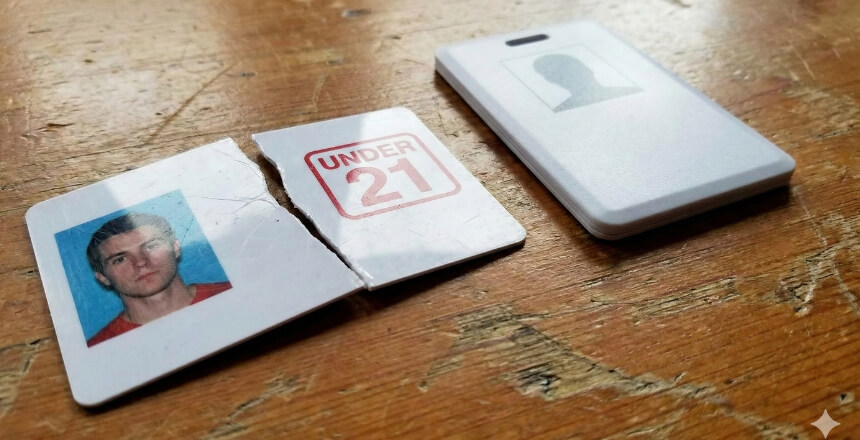
Why Your Cheap Fake ID Will Snap in Half (The $30 Mistake)
You are staring at two websites. Site A charges $100. Site B charges $30.
They both show pictures of the same ID. They both promise “High Quality.” They both claim to be the best.
So, naturally, you want to save $70. You buy the cheap one.
Three weeks later, you are standing in line at a club. You are nervous. You start fidgeting with your ID in your pocket. You bend it slightly. CRACK.
A white crease line appears across the laminate. The edge starts to peel. You haven’t even handed it to the bouncer yet, and the card is destroyed.
You just wasted $50 to buy a piece of garbage.
Here is the hard truth: The difference between a $30 ID and a $100 ID isn’t the picture. It is the physics.
In this guide, I am going to teach you the Bend Test. I will explain the molecular difference between cheap PVC and industrial Polycarbonate, and I will show you why one cracks like a dry cracker while the other snaps back like a spring.
Why Do Cheap IDs Crack? (The Sandwich vs. The Cake)
To understand why your cheap ID failed, you have to understand how it was built.
Most budget vendors use PVC (Polyvinyl Chloride). PVC is cheap. It is easy to print on. But it has a fatal flaw: It doesn’t bond.
The “Sandwich” Analogy: Think of a cheap PVC card like a sandwich.
- Layer 1: Plastic.
- Layer 2: Ink (Your photo and info).
- Layer 3: Plastic laminate (The overlay).
The ink is just sitting between the two slices of plastic. It is not sticky. It is basically a layer of dust. When you bend a sandwich, what happens? The layers slide against each other. The bread pulls away from the meat. The sandwich opens.
In a PVC card, this sliding causes Delamination. The clear top layer peels away from the plastic core because nothing is holding them together except weak static friction.
The “Cake” Analogy (Our IDs): Now, look at a high-quality ID made from Teslin or Polycarbonate. We don’t print on the surface. We fuse into it. Think of this like baking a cake.
- We take the ingredients (the plastic, the ink, the security chips).
- We put them in a high-heat lamination press (the oven).
- They melt. They mix. They fuse.
When you take a cake out of the oven, can you peel the eggs out of the flour? No. They have chemically become one solid object. If you bend a cake (or a sponge), it flexes. It doesn’t peel.
This is why topfakeids.com costs more. We are baking cakes. The other guys are making cheap sandwiches.
What Exactly Is The Bend Test?
You have seen it in movies. A bouncer takes the ID and bends it into a “U” shape.
What is he testing for? He is testing the Flexibility Modulus of the material.
The PVC Fail: If you take a rigid PVC card (like a credit card or a library card) and bend it 180 degrees:
- The Crease: The stress turns the plastic white. This is called “stress whitening.” It creates a permanent ugly white line across your face.
- The Snap: If you push too hard, it snaps in half.
- The Bubble: The air pocket created by the bend causes the laminate to lift up.
The Polycarbonate/Teslin Pass: If you take a real ID (or a high-end fake) and bend it:
- The Flex: It offers resistance. It feels stiff, but it bends.
- The Return: The second you let go, it snaps back to perfectly flat.
- No Damage: There is no white line. There is no peeling. It looks exactly like it did before.
Real government IDs are designed to live in people’s back pockets for 5 years. They are designed to be sat on. If your fake ID can’t survive being sat on, it’s not an ID. It’s a prop.
What Is “Teslin” And Why Is It Magic?
You will hear this word a lot if you research Material Science. Teslin is the secret weapon of the ID industry.
It is not standard plastic. It is a Microporous Matrix. Imagine a microscopic sponge. Teslin is filled with millions of tiny air holes (pores).
Ink Absorption vs. Surface Printing:
- On PVC: The ink sits on top of the hard plastic surface. It can be scraped off with a fingernail.
- On Teslin: The ink flows into the pores. It soaks deep into the material, like water into a sponge.
When we laminate a Teslin card, the liquid laminate flows into those same pores. It grabs the ink and the plastic and locks them together physically. This creates a tamper-evident bond.
If you try to peel a Teslin card, you will literally rip the card apart fiber by fiber. You cannot separate the layers because there are no layers anymore.
The “Snap” Sound: Can You Hear Quality?
Bouncers don’t just use their hands. They use their ears.
There is an auditory component to the Bend Test.
The “Thud” (Fake): Drop a PVC card on a wooden bar counter. Sound: Thud. It sounds dull. It sounds like a piece of cardboard or a heavy credit card.
The “Clack” (Real): Drop a Polycarbonate ID on the counter. Sound: Clack. It sounds high-pitched. It sounds metallic. It sounds like a poker chip hitting the table.
This sound comes from the density of the fused Polycarbonate. Because the card is one solid “monolith” (a single stone), it vibrates differently than a card made of glued layers.
Bouncers hear this sound 500 times a night. If your card goes thud, their subconscious brain immediately says “Fake.”
How Can You Test Your ID at Home?
You don’t want to find out your ID fails the Bend Test when a bouncer is holding it. You want to know now.
Here is the safe way to audit your card without destroying it.
Step 1: The “Taco” Grip Hold the ID by the short edges (left and right) between your thumb and middle finger. Squeeze gently to bow the card out.
- Result A: It feels flimsy and offers no resistance. (Verdict: Cheap PVC).
- Result B: It feels stiff and fights back against your hand. (Verdict: Polycarbonate/Teslin).
Step 2: The Edge Check Look closely at the edge of the card under a bright light.
- Result A: You can see a distinct line where the clear plastic meets the white core. If you pick at it with your fingernail, it catches. (Verdict: Delamination risk).
- Result B: The edge looks like one solid white block. You cannot see where the layers start or stop. (Verdict: Fused).
Step 3: The Light Flex Bend the card about 45 degrees. Let it go.
- Result A: It stays slightly bent or curved. (Verdict: Poor memory).
- Result B: It snaps back to flat instantly. (Verdict: High memory).
The Verdict: Is Saving $70 Worth It?
Let’s do the math again.
You buy the $50 PVC ID. It arrives. It looks okay. Two weeks later, the corner peels in your wallet. It now looks fake. You have to throw it away. Now you have to buy the $100 ID anyway to get one that works.
Total Cost: $150. (And you waited twice as long).
Or, you buy the $100 Polycarbonate ID from topfakeids.com the first time. It survives the bend. It survives the wallet. It lasts for 3 years.
Total Cost: $100.
The “Bend Test” isn’t just a physical test. It’s an IQ test. Smart buyers understand that durability is value.
Don’t buy the sandwich. Buy the cake.